Alexander Rostov and Sofia
A Gentleman in MoscowAlexander Rostov and Sofia’s relationship grows from an act of trust into a father-daughter bond, though the scenes establish this change through everyday gestures rather than any formal declaration. Nina first places her five- or six-year-old daughter in Alexander Rostov’s care while she pursues her imprisoned husband. Years later, Sofia calls him Papa, a small change in address that marks how far their relationship has moved beyond the original request for help.
An Unexpected Responsibility
Nina comes to Alexander Rostov with little time to spare. She explains that she and Leo had been recalled from Ivanovo for a conference on agricultural planning; on its first day, Leo was arrested. Nina tracked him to the Lubyanka but could not see him. After learning that he had received a five-year corrective-labor sentence and would be sent to Sevvostlag that night, she decided to follow him. Before she could get settled, Sofia needed someone to look after her.
The request makes Alexander Rostov responsible for a child at the moment Nina herself is preparing to leave. Sofia is not an abstraction in this exchange: Alexander Rostov follows Nina’s glance across the lobby to a small girl whose feet dangle from a high-backed chair. Nina asks for help because, as she tells him, she has no one else to turn to. Her impending departure gives the relationship its immediate conditions: Alexander Rostov must become Sofia’s reliable adult while Nina goes after Leo.
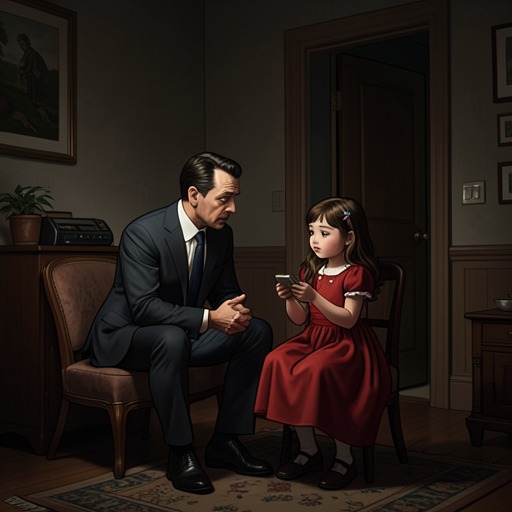
Nina introduces Sofia at eye level. Kneeling beside her, she rests a hand on the child’s knee and speaks in a tenderness Alexander Rostov has never heard from her before. She tells Sofia that Alexander Rostov is her Uncle Sasha, someone she has heard about often. The intimacy of the introduction matters: Nina does not hand Sofia over without preparation, but places Alexander Rostov within a family vocabulary the child can recognize.
Sofia’s question about the pretty binoculars shows that Alexander Rostov is already present in her life through stories and a remembered gift. She is not meeting a complete stranger; she has an image of him before she meets him face to face. Her simple clothes, very short hair, and linen doll without a dress are described as signs of Nina’s practical habits. The scene thus presents the child through both her own small belongings and the mother whose care has shaped her.
Friendship Behind the Request
Alexander Rostov’s willingness to help rests on a history older than Nina’s crisis. He remembers Nina as the child who once crossed the Piazza without hesitation to become his friend. She showed him the hotel’s hidden corners and gave him, in the story’s phrasing, the key to its mysteries. When that same friend asks for help, especially when asking does not come naturally to her, Alexander Rostov sees no acceptable response other than to agree.
The older friendship gives the new responsibility a particular shape. Nina is not simply assigning childcare to a convenient acquaintance; she is entrusting her daughter to someone whose kindness and loyalty she has known since childhood. For Alexander Rostov, the obligation is correspondingly personal. After Nina’s appeal, he slips a photograph into his pocket, composes himself, and turns to Sofia as his new charge. The photograph’s contents are not specified, but the gesture accompanies his inward preparation to take responsibility.
The relationship also begins with a difference between adult intention and a child’s immediate concerns. Alexander Rostov offers to find out whether Sofia is hungry; she shakes her head. At the introduction, she is more interested in recognizing the person connected with the binoculars than in the gravity of her mother’s appeal. The contrast keeps the scene grounded in Sofia’s perspective: a major change in her care arrangements reaches her through familiar names, objects, and the presence of a new adult beside her.
Care Made Ordinary
In a later bedtime scene, Sofia’s conduct suggests ease with Alexander Rostov and familiarity with their shared routine. When they leave Marina’s, she is ready for bed and does not let go of his hand. She leads him through the lobby to the elevator, presses the fifth-floor button with the assurance of someone who knows where she is going, and practically drags him up the final stairs to the belfry. Alexander Rostov introduces her to their new bunk bed, but she scarcely notices it; her priorities are brushing her teeth and changing into her nightgown.
The sequence gives the relationship substance through small, practical actions. Sofia holds Alexander Rostov’s hand, takes charge of the route, and moves through the evening’s routines without hesitation. He, in turn, is there to accompany her and make a place for her to sleep. The new bunk bed makes the arrangement concrete, while Sofia’s indifference to its ingenuity suggests that, at that moment, the familiar order of bedtime matters more to her than the novelty of the furniture.
Her confidence does not mean that every need is stated aloud. After returning from the bathroom, Sofia climbs onto the desk chair instead of getting into bed. Alexander Rostov asks whether she is ready for bed, surprised by the detour. The scene leaves the reason for her action in what follows rather than turning it into a general account of their domestic life; even so, it shows an adult watching for what the child needs and a child sufficiently at home to depart from the expected routine.
From Uncle to Papa
By the time Sofia is thirteen, Alexander Rostov’s rooms hold a different image of their bond. He opens the door expecting to find her elsewhere, but she is seated at the desk, leaning diligently over a large book. Without looking up, she greets him as Papa. The address makes their changed relationship audible: the girl introduced as his niece-like charge now names him in the language of a father.
Her concentration is as revealing as the name. Sofia stays absorbed in her book as Alexander Rostov enters, and he responds with a wry comment that it is apparently no longer polite to look up from work when a gentleman comes in. His remark acknowledges her independence and his familiarity with it; the exchange is not a formal reckoning of how they became a family, but an ordinary moment between people whose roles have settled into a shared life.
Across these scenes, the shift from Uncle Sasha to Papa is supported by repeated care rather than a declared change of status. Nina’s urgent trust begins the relationship, the routines of food, bedtime, and shared rooms give it daily form, and Sofia’s later greeting supplies its clearest name. The bond also revises Alexander Rostov’s role: Nina’s old friend becomes Sofia’s guardian in practice and, eventually, the father she calls him.